
Careful attention must always be paid to the aortic trace. This image shows an example of a ventricularised aortic pressure trace.
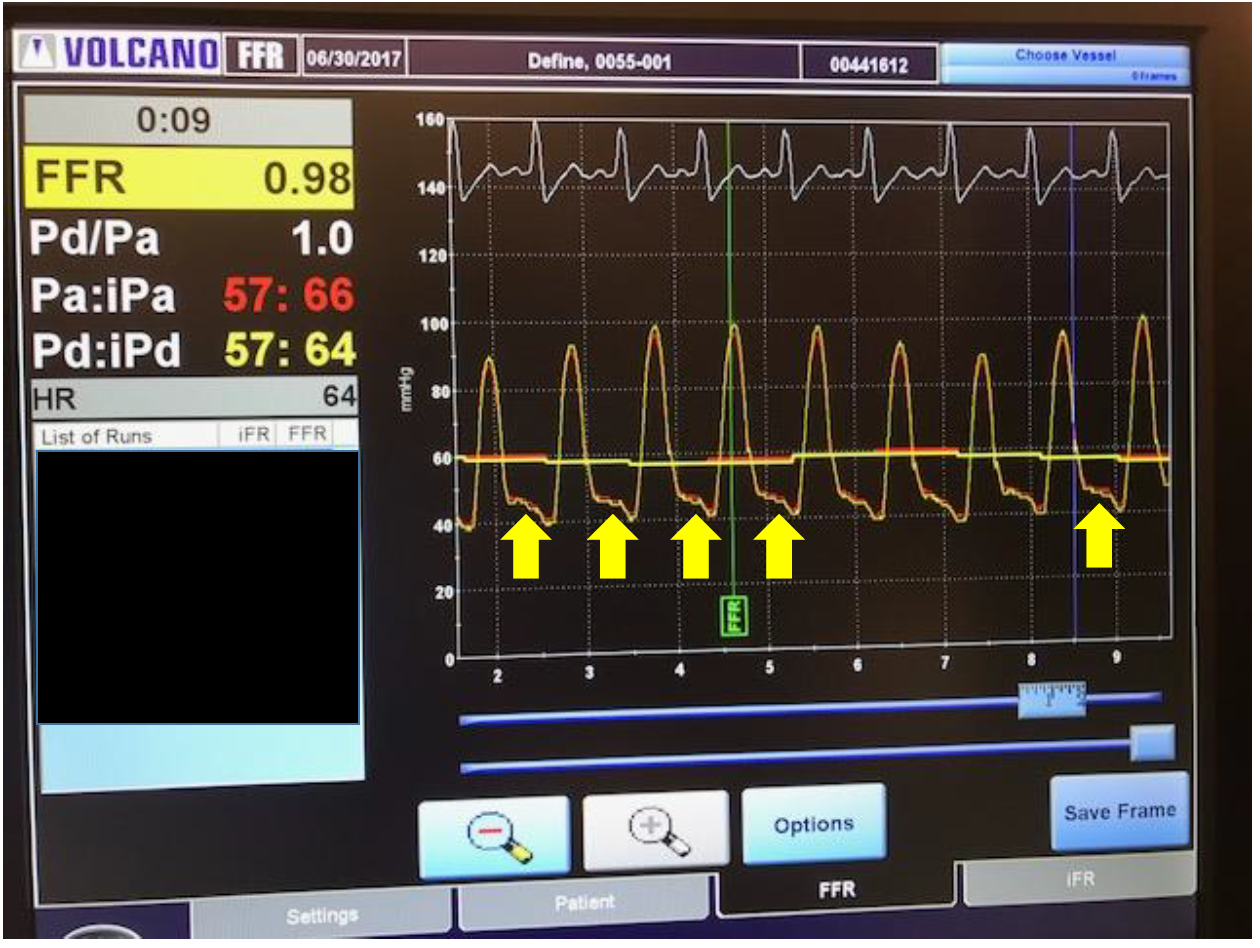
There should be a crisp trace and the dichrotic notch should be a clear dichrotic notch to ensure there is no pressure damping or ventricularisation. If ventricularisation or damping of the aortic trace is present, this will lower your Pa value. This will then have the consequence of affecting your iFR value, giving you a falsely elevated value. This could then potentially lead to stenosis misclassification, as a lesion may be considered negative when it is truly positive due to the effect of pressure damping.
If pressure damping or ventricularisation is present, then the guiding catheter should be disengaged and the Verrata wire should be normalised in the aortic root. The guiding catheter can then be re-engaged and the Verrata wire advanced distally. When the wire is distal, the guide catheter should again be disengaged before making your iFR measurement. Careful attention should always be paid to the aortic trace to ensure the dichrotic notch is present and there is no damping or ventricularisation.
Support by Volcano-Philips